Ministry leadership framework · Valence–Arousal
When a Church Disagrees.

A ministry's responsibility for conviction and people continues after the decision. Valence-Arousal helps us notice what we do with that tension.

A church can finish an argument and still have a great deal of unfinished work with God.
The motion passes. The statement goes out. Somebody finally says what somebody should have said six months ago. People feel relieved, and it is easy to take that relief as evidence that they have acted faithfully.
Sometimes they have. A clear decision can stop a wrong, protect a person, release a burden. Sometimes the relief comes because the people who raised the inconvenient part of the question have stopped talking.
The minutes record both meetings in approximately the same language.
This is where I want to bring a framework I call Valence-Arousal into ministry leadership. The name comes from the language of emotion, but my adaptation asks a particular question: when something we believe is right comes into tension with a person we are called to love, what do we do with the tension?
That question has more to do with lordship than with temperament. The goal is right relationship. Both words have to survive the meeting. This is an interpretive map of our responses, rather than a clinical measure of emotion or a score for spiritual maturity.
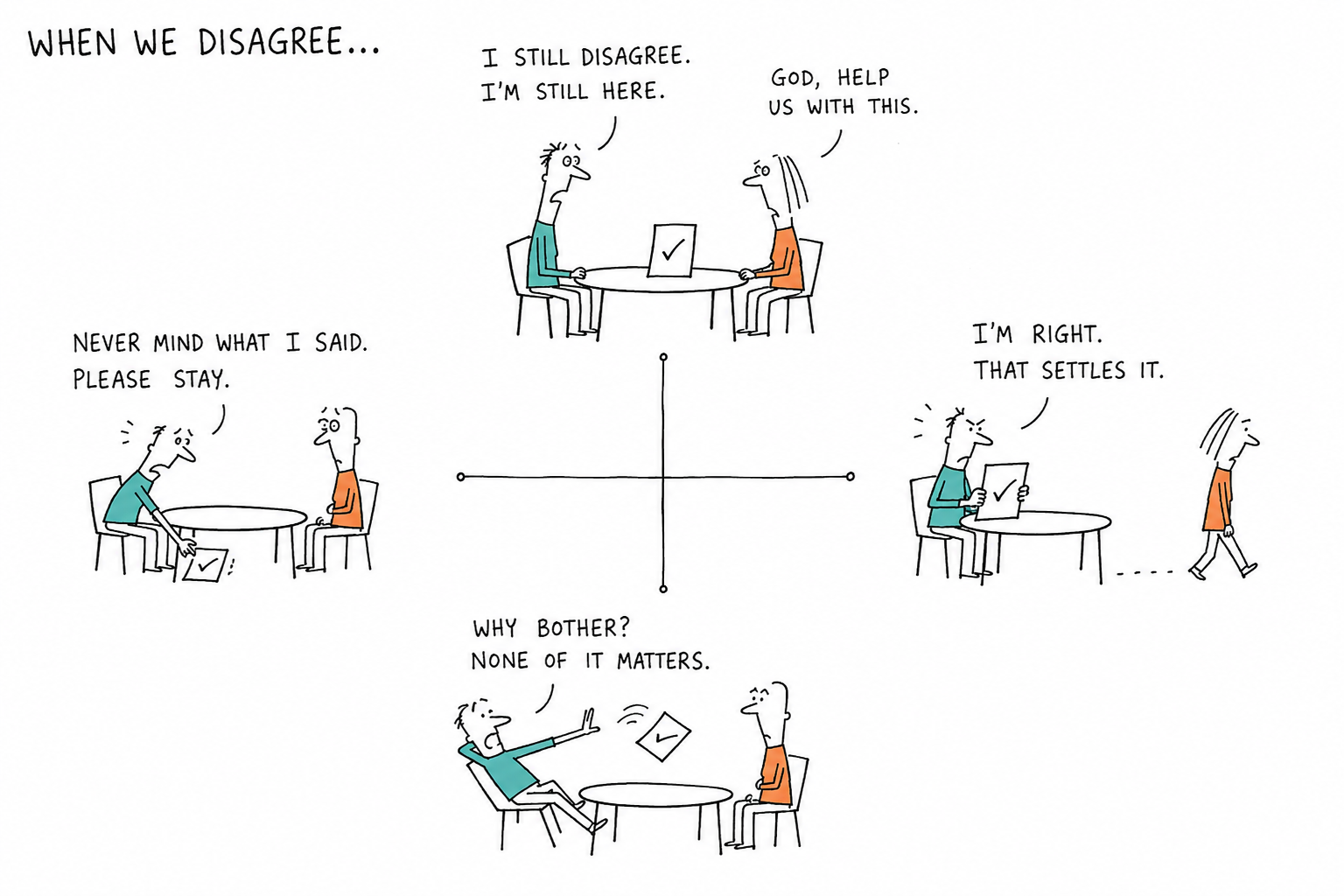 Open full-size illustration
Read the illustration as text
When we disagree: at the top, two people remain at a table with their conviction still present. One says, “I still disagree. I’m still here.” The other says, “God, help us with this.” At the left, someone puts conviction aside: “Never mind what I said. Please stay.” At the right, someone keeps the claim while the other person leaves: “I’m right. That settles it.” At the bottom, someone dismisses both the claim and the conversation: “Why bother? None of it matters.” These scenes illustrate responses we can move between, not fixed personalities or measured scores. The invitation is to keep right and relationship consequential and entrust unresolved tension to God.
The good we organize around
Consider an imagined disagreement about whether a congregation should change a long-established practice. One leader starts with the conviction the practice protects. Another starts with the people for whom it has become painful or excluding. Each can hear the other as carelessly setting aside the central obligation of Christian faith.
The people involved have competing concerns, each of which deserves to be heard.
I use the word plumbline for the good by which we judge a decision. For one person, certainty and justice supply that line. For another, mercy and attention to a person's experience supply it. Those goods are consequential. The trouble begins when our preferred good becomes permission to discard every claim it cannot comfortably contain.
A doctrinally clear person can remain deeply available to someone who disagrees. A compassionate person can refuse a request that would hurt someone. Neither clarity nor kindness, by itself, tells us how a person will handle the collision.
We have to watch what happens next.
One response preserves the conviction by making relationship expendable. We have established the rule, and the other person's life has become somebody else's department. Another response preserves the immediate relationship by surrendering the conviction at issue. We have kept the group together, although it is getting harder to say what its members believe.
There is a third way to get relief. We can decide the whole thing is ridiculous. Churches always do this. People always do that. Nothing changes. Cynicism offers the unusual convenience of being disappointed in advance.
That response can be quiet, but it can also be loud and combative. The defining move is to make the stakes insignificant enough that we no longer have to answer for them. Rest, privacy, and stepping away from a fruitless argument are different matters. A person can leave a meeting and continue praying seriously for its people.
What the vertical direction means
In my adaptation, the vertical direction concerns what we do with the burden. Moving upward means accepting greater engagement in the work of holding right and relationship together. Moving downward means increasingly denying that the stakes deserve that engagement. Emotional volume does not tell us which direction someone is moving.
The work at the top is costly because it denies us several familiar exits. We remain answerable to what we believe is true. We remain answerable for how we treat the person. We also admit that the resolution may exceed our wisdom, authority, or remaining strength.
For Christians, this becomes intercession. We bring an actual unresolved situation to an actual Lord. We ask for help, accept correction, and take the next responsibility that belongs to us. God receives more than a ceremonial mention before we return to executing our preferred answer.
A framework cannot confer this capacity. We need God, and dependence on Him does not make us consistent. I am interested in a direction of faithfulness we can return to when we stumble. Awarding ourselves the most mature position on a diagram would make a fairly efficient new hiding place.
The responsibility stays concrete
Suppose a ministry learns that a trusted volunteer has repeatedly ignored an agreed boundary. This is an illustration, not an account of a particular church.
The leader's responsibilities may include stopping the conduct, hearing the people affected, restricting the volunteer's role, and finding out what actually happened. Continued concern for the volunteer does not cancel those actions. The people affected have claims on the ministry's care too.
The question is whether a necessary boundary becomes the end of our concern for a person, or whether our concern becomes an excuse to leave others exposed. Right relationship requires us to resist both temptations. It may involve a firm decision, several separate conversations, and a long period in which trust has not returned.
We should be especially careful when the person invoking reconciliation is also the person who controls employment, access, or reputation. An invitation from that chair can land as a requirement. A leader may feel gracious while the other person is calculating what disagreement will cost.
Ask who must deal with the unresolved problem. If the least powerful person pays every cost so that leaders can call the group peaceful, examine that arrangement.
Listening after the decision
Ministries already receive accounts of what people experience. Some arrive as gratitude. Others arrive as a hesitant conversation in a hallway, a resignation, or a story whose ending does not fit the update we hoped to share.
The framework can help us hear these accounts without treating them as grades awarded to the institution. What mattered to this person? What did they believe was threatened? What did we do with their concern? Where did someone remain available at real cost?
A grateful account may help us notice care we would otherwise have missed. A painful one may reveal a broken promise. Neither permits us to read a person's entire spiritual condition, or to announce that a ministry has achieved a measurable level of faithfulness. The witness has a voice. God keeps His chair.
We can also hear ourselves. Notice the moment when a testimony becomes useful mainly because it validates a decision we already made. We may still publish a truthful, freely offered account with appropriate permission. But listening deserves a purpose beyond acquiring a favorable exhibit.
A question for the next hard meeting
Before the next consequential disagreement, write down the conviction you believe must remain intact. Then write down the people whose dignity, agency, and care must remain consequential. Include the people who will never sit at that table.
When discussion starts moving toward relief, look at the two lines. Has the proposed decision dealt responsibly with both? What can be decided now? What still needs inquiry, repair, patience, or prayer? Who will remain available when the announcement has gone out?
There may be no answer that makes everybody happy. A faithful decision can disappoint people and still leave a leader with work to do. The invitation is to keep bringing that work to God without making either conviction or relationship disappear to ease our own discomfort.
The meeting can end. Our care does not have to end with it.
For the fuller exploration, read Keeping Conviction and Relationship Together.
Written with AI drafting assistance.